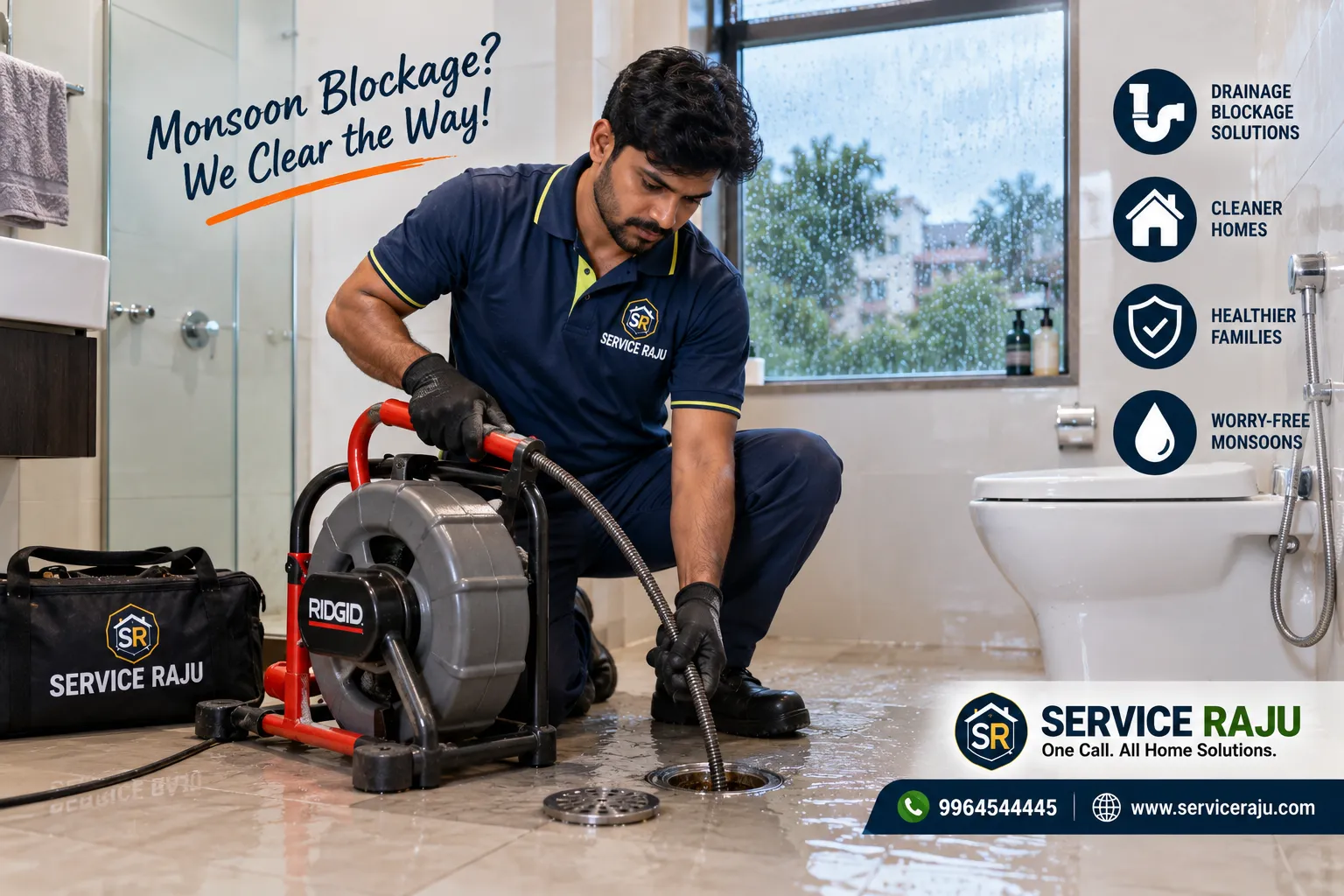
Drainage Blockage During Monsoon in Mysore: Causes, Risks and Solutions
1. Drainage Blockage During Monsoon in Mysore: Causes, Risks and Solutions
Every monsoon season in Mysore, one of the most urgent calls that plumbers receive is simple and urgent: "Water is not draining — it is coming back up."
Drainage blockage during monsoon is not the same as an ordinary slow drain. When heavy Karnataka monsoon rains hit, the volume of water moving through household drainage systems multiplies rapidly. A drain that was slow but functional in May becomes completely blocked in July. Kitchen sinks back up. Bathroom floors flood. Underground drainage lines overflow. And the consequences go beyond inconvenience — stagnant drainage during monsoon creates genuine health hazards and can cause serious structural damage if left unaddressed.
This guide explains exactly why monsoon drainage blockages happen in Mysore homes, how to recognise the warning signs early, what you can do at home, and when professional drainage service is the only safe solution.
2. Table of Contents
- Why Monsoon Turns a Slow Drain Into a Serious Problem
- How Drainage Blockages Develop in Mysore Homes
- Types of Drainage Blockage Common During Monsoon
- Warning Signs Your Drainage System Is Failing
- Health and Property Risks of Blocked Drains During Monsoon
- What Homeowners Can Try Before Calling a Plumber
- When Professional Drainage Service Is Essential
- How Service Raju Clears Drainage Blockages in Mysore
- Drainage Repair and Unblocking Cost in Mysore
- How to Prevent Monsoon Drainage Blockage
- FAQs
- Final Takeaway
3. Why Monsoon Turns a Slow Drain Into a Serious Problem
A partially blocked drain has a limited but functional flow capacity. In dry months, this is often sufficient — water drains slowly but it drains. The problem is hidden.
When monsoon rains arrive, three things change simultaneously:
Water volume increases dramatically. Roof rainwater, courtyard runoff, and washing activity all increase. The drainage system must handle significantly more water in a shorter time than it was designed for under a partial blockage.
External drainage systems become overwhelmed. Municipal drainage lines in many parts of Mysore — particularly in older residential layouts like Saraswathipuram, Yadavagiri, Nazarbad, and parts of Jayalakshmipuram — were designed for rainfall loads from decades ago. During heavy monsoon, these lines fill rapidly, reducing the outfall pressure that your home drainage relies on. This causes backflow — wastewater returning upward through floor traps and sinks inside your home.
Debris load increases. Monsoon rain carries leaves, soil, and silt into outdoor drain channels and drainage gully traps. This debris compacts existing blockages and creates new ones very quickly.
The result: a slow drain in May becomes a completely blocked, backflowing drain by the first heavy rains of July.
4. How Drainage Blockages Develop in Mysore Homes
Drainage blockages rarely happen overnight. They build over months through accumulation. Monsoon simply reveals and accelerates what was already developing.
Kitchen drain accumulation: Every day, cooking oil, food particles, soap residue, and vegetable waste enter the kitchen drain. Over time, grease coats the inner surface of the drainage pipe and narrows the flow channel progressively. Indian cooking — which uses significantly more oil and coconut-based ingredients — accelerates this accumulation.
Bathroom drain accumulation: Hair, soap scum, and personal care product residue build up inside bathroom drain pipes and in the P-trap below the drain point. In Indian bathrooms where bucket bathing is common, the volume of soapy water is higher, accelerating trap blockage.
Toilet drain issues: Blockages in toilet drainage are often caused by inappropriate materials being flushed — wet wipes, tissue paper, sanitary products — combined with low water pressure that is insufficient to clear waste through older, narrower drainage pipes.
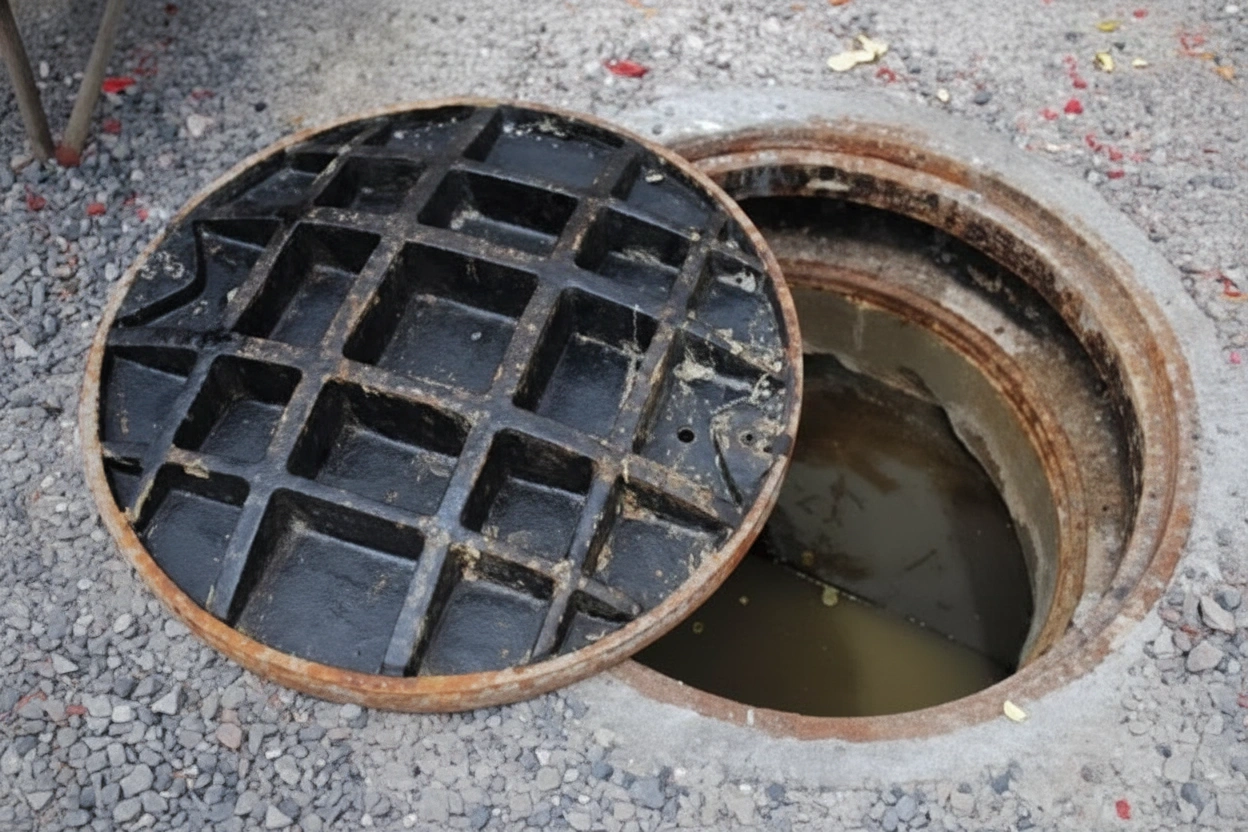
Outdoor gully traps and drainage channels: Many Mysore homes have open or semi-covered outdoor gully traps that collect rainwater from the roof, courtyard, and service areas. During monsoon, these fill with leaves, soil, and debris rapidly — blocking the outfall and causing water to back up into the compound or into the home itself.
Underground drainage line failure: In older Mysore residential properties, underground drainage lines are sometimes made from clay or older PVC that has cracked, root-invaded, or partially collapsed over decades. These lines may function adequately in dry months but fail completely under monsoon load.
5. Types of Drainage Blockage Common During Monsoon
| Blockage Type | Location | Common Cause |
|---|---|---|
| Grease blockage | Kitchen sink drain | Oil and food particle accumulation |
| Hair and soap blockage | Bathroom drain / P-trap | Hair, soap scum buildup |
| Toilet blockage | Toilet drain pipe | Inappropriate materials flushed |
| Gully trap blockage | Outdoor compound drain | Leaves, soil, monsoon debris |
| Underground line blockage | Main drainage line | Root invasion, pipe collapse, silt |
| Backflow blockage | All indoor drains | Municipal line overflow during heavy rain |
| Terrace drain blockage | Roof drain outlet | Leaves and debris on terrace |
6. Warning Signs Your Drainage System Is Failing
Recognise these signs early — before the problem becomes an emergency:
- Water draining very slowly from kitchen sink, bathroom floor, or washbasin — the earliest and most actionable warning
- Gurgling sounds from floor drains or toilet when water is released from another fixture — indicates air trapped by a partial blockage downstream
- Foul smell rising from floor traps or drains — particularly strong during monsoon when organic matter in blocked pipes decomposes faster in warm, humid conditions
- Water backing up into the bathroom floor when the kitchen drain is used — indicates a common downstream blockage
- Toilet water rising higher than normal before draining slowly — early sign of toilet drain restriction
- Outdoor compound flooding that does not drain within 30 minutes of rain stopping — gully trap or underground line blockage
- Wastewater appearing at the base of the compound wall — serious underground drainage failure requiring immediate professional attention
- Multiple drains failing simultaneously — indicates a main drainage line blockage, not individual fixture blockages
If multiple drains in your home are failing at the same time, do not attempt home remedies. This indicates a main line blockage that requires professional equipment to clear.
7. Health and Property Risks of Blocked Drains During Monsoon
Blocked drains during monsoon are not merely an inconvenience. The risks are real and significant.
Health risks:
Stagnant wastewater that backs up into bathrooms and kitchens during monsoon creates direct exposure to pathogens. Blocked drains are a breeding environment for:
- E. coli and other faecal bacteria from toilet drain backflow
- Mosquito breeding in standing water in blocked outdoor drains — a direct link to dengue and malaria risk, which peak during Karnataka monsoon
- Fungal growth on bathroom and kitchen surfaces kept permanently damp by poor drainage
- Leptospirosis risk from exposure to floodwater contaminated by sewage backflow
According to the National Centre for Disease Control (NCDC), waterborne and vector-borne diseases including dengue, malaria, typhoid, and leptospirosis show their highest annual incidence during and immediately after the monsoon season in urban India.
Property damage risks:
- Persistent moisture from poor drainage seeps into flooring, causing tile adhesive failure and tile lifting
- Moisture penetrating wall bases causes plaster damage and paint peeling
- Stagnant water in compounds causes foundation dampness in ground-floor homes
- Wooden furniture, cabinetry, and door frames warp and rot when exposed to persistent drainage moisture
- Unresolved drainage backflow can damage washing machine drain connections and appliance bases
8. What Homeowners Can Try Before Calling a Plumber
For minor, single-fixture blockages that are clearly recent and shallow, these approaches may help:
Hot water flush: Pour 2–3 litres of very hot (not boiling) water slowly into a blocked kitchen drain. Hot water can temporarily soften and shift grease blockages near the drain opening. This works only for early-stage grease accumulation.
Plunger: A standard cup plunger can generate sufficient pressure to dislodge a shallow blockage in a kitchen sink or washbasin. Ensure the plunger cup fully covers the drain opening and use firm, consistent pressure. Do not use a plunger if you have recently used a chemical drain cleaner.
Remove and clean the P-trap: Under a kitchen sink or washbasin, the P-trap is a common blockage location. Place a bucket under it, unscrew the P-trap fittings, clean out the accumulated material, and refit. This is a straightforward task for anyone comfortable with basic DIY.
Clean the bathroom drain cover: Remove the drain cover and clear any visible hair and soap accumulation immediately below the drain opening using a hooked wire or drain cleaning tool.
Do not use chemical drain cleaners in the following situations:
- If the drain is completely blocked with no flow — the chemical will pool above the blockage with no useful effect and create a hazardous chemical pool
- If you have older PVC or metal pipes — strong caustic chemicals can damage pipe joints
- If the blockage is in an outdoor or underground line — chemicals will not reach the blockage location
9. When Professional Drainage Service Is Essential
Home remedies are insufficient in these situations — and attempting them can make the problem worse:
- Multiple drains blocked simultaneously — main line blockage requires jet rodding or mechanical clearing equipment
- Wastewater backflow inside the home — immediate professional intervention needed to prevent health hazard
- Outdoor drainage not clearing hours after rain — underground line or gully trap requires professional clearing
- Toilet completely blocked — toilet drain clearing requires professional tools and correct technique
- Recurring blockage — same drain blocking repeatedly indicates a structural problem requiring diagnosis
- Foul smell persisting after attempted home clearing — indicates organic matter trapped beyond DIY reach
- Suspected underground line damage — requires camera inspection or rodding equipment
10. How Service Raju Clears Drainage Blockages in Mysore
Service Raju provides professional drainage and blockage solutions across Mysore and Bengaluru. The process is direct and efficient:
- Contact Service Raju at 9964544445 or 9620550955, or book at www.serviceraju.com
- A qualified plumber is assigned to your location in Mysore or Bengaluru
- The plumber identifies the blockage type and location — single fixture, main line, gully trap, or underground line
- The appropriate clearing method is selected — manual rodding, mechanical drain snake, high-pressure jetting, or gully trap clearing
- The blockage is cleared and the drainage flow is verified with a water test
- The plumber inspects the cleared section for any pipe damage, incorrect slope, or structural issue
- You receive a clear explanation of what caused the blockage and what preventive steps will help
- Any additional plumbing repairs are quoted and carried out with your approval
Service Raju also provides general plumbing repair, toilet installation and replacement, and plumbing consultation where drainage problems reveal a wider plumbing issue.
For national guidance on sanitation and drainage standards, the Swachh Bharat Mission provides useful reference information on household sanitation maintenance.
11. Drainage Repair and Unblocking Cost in Mysore
Indicative market price ranges for drainage services in Mysore and Bengaluru (2025–2026 market reference):
| Service | Indicative Market Range |
|---|---|
| Kitchen or bathroom drain unblocking (manual) | ₹400 – ₹900 |
| Toilet drain unblocking | ₹500 – ₹1,200 |
| Gully trap clearing and cleaning | ₹600 – ₹1,500 |
| Main drainage line clearing (mechanical rod) | ₹1,500 – ₹3,500 |
| High-pressure jet drain cleaning | ₹2,500 – ₹6,000 |
| Underground drain inspection and repair | ₹3,000 – ₹10,000+ |
| Drain pipe joint repair | ₹800 – ₹2,500 |
| Plumbing consultation and inspection | ₹300 – ₹600 |
Note: Prices vary based on blockage location, severity, access difficulty, and pipe type. Contact Service Raju at 9964544445 for a specific estimate.
12. How to Prevent Monsoon Drainage Blockage
- Clean all gully traps and outdoor drain covers before monsoon. Remove accumulated leaves, soil, and debris from all outdoor drainage points in June before the heavy rains begin.
- Do not pour cooking oil down the kitchen drain. Collect used cooking oil in a container and dispose of it with solid waste.
- Install a hair-catcher in all bathroom drains. A simple mesh drain cover prevents the majority of hair accumulation that causes bathroom drain blockages.
- Flush toilets only with water and toilet paper. Wet wipes, tissue rolls, and sanitary products should never be flushed.
- Pour a bucket of water through all floor drains monthly. Unused floor drains dry out, allowing sewer gas to enter. Regular water flushing keeps drain traps sealed.
- Keep terrace drain outlets clear. Terrace drain blockages cause roof water to back up and create roof leakage during monsoon.
- Have your main drainage line inspected if your home is more than 10 years old and has never had a professional drainage check.
13. FAQs
14. Why does my bathroom drain back up only during heavy rain — it drains fine otherwise?
This is a classic sign of external drainage backflow. During heavy monsoon rain, the municipal drainage line your home connects to fills to capacity. With nowhere to go, the water pressure reverses and pushes wastewater back up through the lowest drainage points in your home — typically bathroom floor drains. A plumber can assess whether a non-return valve installation would help your specific situation.
15. Can I use a chemical drain cleaner to clear a monsoon blockage?
Chemical cleaners work only on certain types of blockage and only when there is still some residual flow through the drain. If the drain is completely blocked, the chemical pools above the blockage and causes no useful clearing. For monsoon blockages, which are often compacted by debris and backflow, mechanical clearing by a professional is significantly more effective and safer.
16. My kitchen drain smells terrible during monsoon even though it drains fine. Why?
During monsoon, warm and humid conditions accelerate the decomposition of organic material trapped inside drain pipes. Even a drain that is flowing adequately can emit foul odours from accumulated grease and food matter on the inner pipe surface. A professional drain cleaning — which clears the inner pipe surface rather than just unblocking the flow path — is the effective solution.
17. How often should drainage be professionally cleaned in a Mysore home?
For a typical Indian home in Mysore, a professional kitchen drain cleaning once per year (ideally before monsoon) and a main drainage inspection every 2–3 years is a reasonable maintenance schedule. Homes with older drainage systems, large families, or previous blockage history may benefit from more frequent service.
18. Is it normal for the toilet water to rise when someone uses the kitchen tap?
No. This indicates a blockage in the shared drainage line downstream of where the toilet and kitchen drain connect. When one drain discharges water, the blockage restricts outflow and the pressure is visible in the other connected fixture. This needs professional main line clearing.
19. Does Service Raju handle both indoor drain blockages and outdoor or underground drainage problems?
Yes. Service Raju plumbers in Mysore handle all drainage blockage types — kitchen, bathroom, toilet, gully trap, outdoor drainage channels, and underground line clearing. Call 9964544445 to explain your specific problem and a suitable technician will be assigned.
20. Final Takeaway
Drainage blockage during monsoon in Mysore is not a problem that resolves itself. A blocked drain in monsoon season gets worse with every day of rain — more debris compaction, more backflow risk, more health hazard, and more potential property damage.
The right time to act is the moment you notice the first warning sign — slow drainage, gurgling sounds, or a persistent smell. At that stage, the blockage is almost always still straightforward to clear at a reasonable cost.
Wait until wastewater is backing up into your bathroom during rain, and you are dealing with a significantly more difficult, more expensive, and more disruptive problem.
Do not wait for the drain to fail completely. Book a drainage inspection or unblocking service with Service Raju now — before the next heavy rain makes it worse.
Book your drainage service with Service Raju today:
???? 9964544445 | 9620550955
???? www.serviceraju.com
Available in Mysore and Bengaluru
 AC Repair
.webp) Ant Control Service
Ant Control Service
 Basin & Sink Services
.webp) Bath & Shower Services
Bath & Shower Services
.webp) Bath Fittings & Mirrors
Bath Fittings & Mirrors
 Bathroom Cleaning Service
 Bathroom Renovation Services
 Bed Bug Control Services
 Bedroom Painting
 Book a Carpenter Consultation
 Book Electrical Consulting
.webp) Cabinet Painting & Wood Refinishing
Cabinet Painting & Wood Refinishing
 Chimney Cleaning
 Civil Masonry Work
 Clean-Up Services
.webp) Clothes Hanger Installation
Clothes Hanger Installation
 Cockroach Control Services
---mysore-mysore-standard-300x200.webp) Commercial Cleaning
Commercial Cleaning
 Commercial Pest Control AMC Service
 Cupboard & Drawer Services
 Decorative Wall Panels
 Deep Sanitisation Service
 Detan & Bleach
 Door, Grill & Cabinet Painting Service
.webp) Doorbell & security
Doorbell & security
 Drain Blockage Clearing
 Electrical Appliance Services
 Electrical Wiring Services
 Empty Home Deep Cleaning
.webp) Fabrication
Fabrication
 Facials
.webp) Fan Installation & Repair
Fan Installation & Repair
 Full Home Cleaning Service
 Full Home Renovation
 Furniture Repair Service
 Gas Stove & Hob Repair
.webp) General Pest Control Services
General Pest Control Services
 General Plumbing & Consultation
 Geyser Repair
 Glass Cleaning
 Head Massage
.webp) Honeybee & Wasp-Services
Honeybee & Wasp-Services
 Kitchen & Bathroom Painting Service
 Kitchen Cleaning
 Kitchen Fittings
.webp) Kitchen Renovation
Kitchen Renovation
.webp) Laptop/Desktop service
Laptop/Desktop service
 Leak Detection and Repair
 LED TV Repair
 Living and Dining Room Painting
 Makeup, Saree & Styling
 Manicure & Pedicure
 MCB,Meter & Fuse Services
 Microwave Repair
 Mosquito Pest Control Service
 Multi-Room Painting Service
 Painting Consultation
 Quick Mini Cleaning Services
 Refrigerator Repair
 RO Water Purifier
.webp) Rodent Control Services (Rat & Mice Treatment)
Rodent Control Services (Rat & Mice Treatment)
.webp) Rooms Cleaning
Rooms Cleaning
 Shelves & Decor
 Sofa, Carpet & Mattress Cleaning
 Solar Water Heater Service
 Sump & Tank Cleaning
 Switch & Socket Services
 Tap & Mixer Service
.webp) Termite-Control-Services
Termite-Control-Services
 Threading & Face Wax
.webp) Tile & Granite Installation & Polishing
Tile & Granite Installation & Polishing
 Toilet & Commode Services
.webp) UPS and Inverter Repair Services
UPS and Inverter Repair Services
.webp) Wall Painting Service
Wall Painting Service
 Washing Machine Repair
 Water Level Controllers
 Water Tank and Pump Repair
 Waterproofing
 Waterproofing Services
 Waxing
 Window & Curtain Services
 Wooden Door Services